
By Paula MacKay, Woodland Park Zoo
August 31, 2026
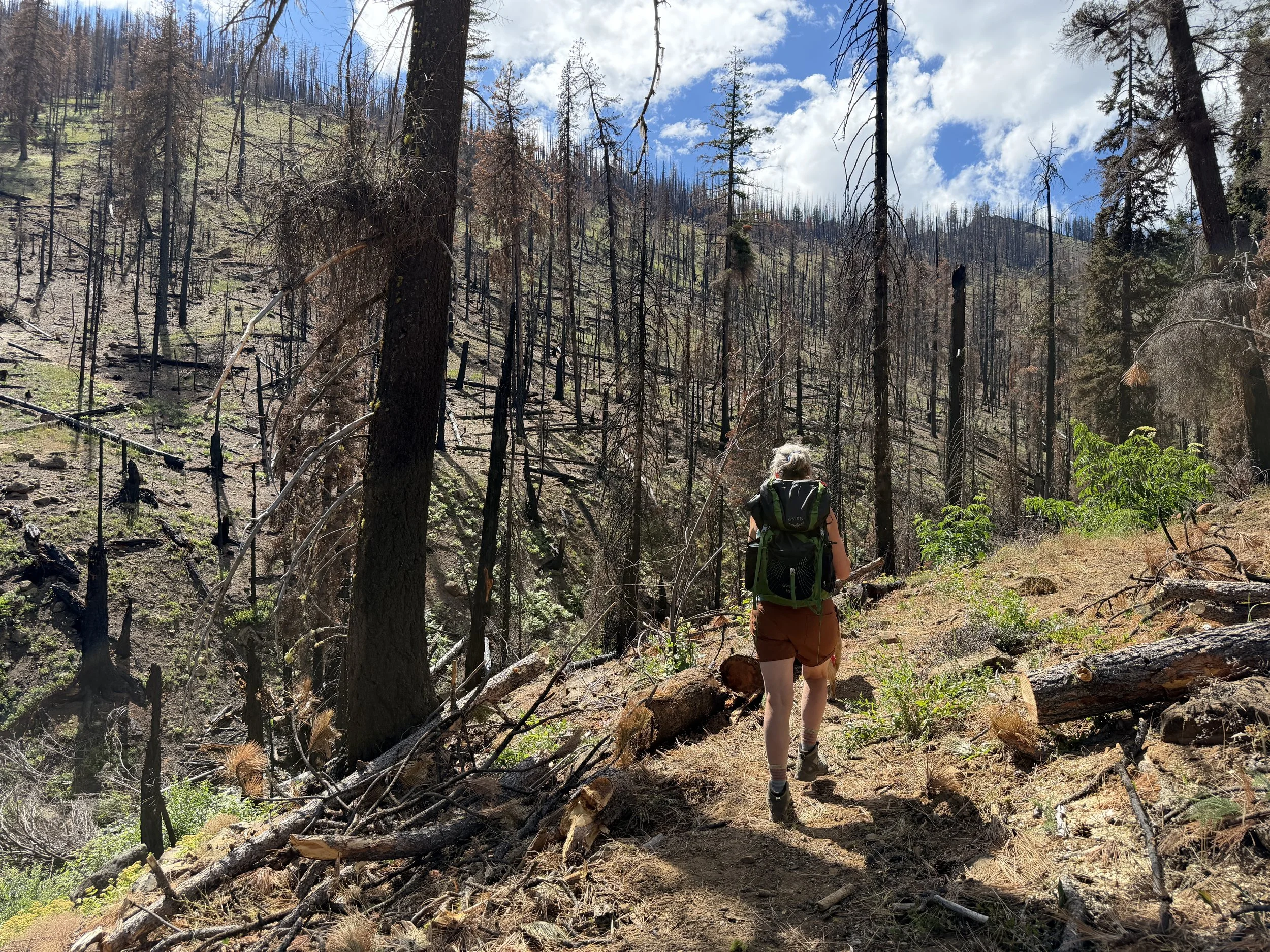
As Dr. Robert Long and I hiked toward one of our overwintered camera stations, my heart sank deeper with every dusty step. The station lay within the perimeter of last September’s Labor Mountain Fire, the damage from which had precluded public access until the Forest Service completed its safety cleanup—still underway on this blazing July day. We’d received official clearance to remove our research equipment by walking the closed road to the trailhead, adding only a mile to the trip. Turns out it was a long mile.
Image: The author hikes toward the burned camera station. Photo: CCMP/WPZ
Robert and I were working on the Teanaway Community Forest east of Cle Elum, as part of our survey efforts with the Cascades Carnivore Monitoring Program (CCMP). In our respective roles as carnivore researchers at Seattle’s Woodland Park Zoo, we co-initiated CCMP in 2021 with Dr. Dan Thornton at Washington State University, who shared our vision for a highly collaborative, long-term monitoring program for wolverines and Canada lynx. Together with a diversity of partners from Native Nations, agencies, nonprofits, and academic institutions, we created CCMP to noninvasively monitor these and other carnivores of conservation concern throughout the Washington Cascades, over a twenty-year period. Thanks to our impassioned partners, dozens of boots hit the ground in 2024.
Well before Robert and I approached the remains of our Teanaway station to retrieve almost a year’s worth of camera data, we knew we were too late. The drought-stressed ponderosas we’d witnessed as we’d set out on the road quickly gave way to spotty hot spots and washouts, with views ahead of charred, serpentine ridgelines crowned in spindly snags. “Maybe the fire skipped our station,” Robert said, his voice choked by an unraveling thread of hope. “Maybe,” I responded, equally reluctant to accept the new reality that awaited us.
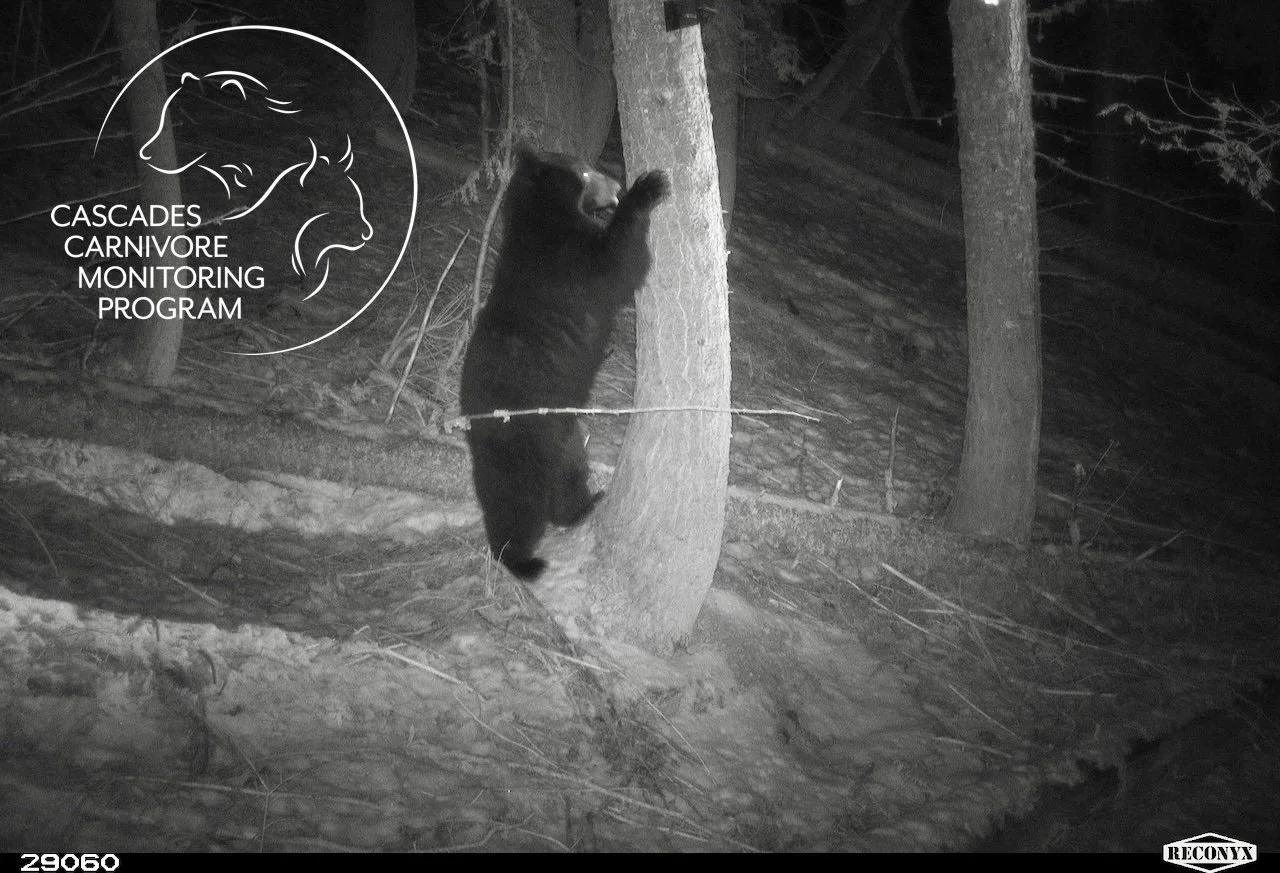
When our GPS told us it was time to leave the trail and bushwack to our station, we peered upslope in disorientation. How could this ashy moonscape possibly be the same place we’d traversed through tangled vegetation to reach the then-living copse of conifers, where we’d first deployed our cameras and automated scent dispenser two years before? Where we’d documented black bears, mule deer, bobcats, martens, coyotes, hares, squirrels, and various birds in the previous year of our survey, fully expecting similar results—possibly even a wandering wolverine—after we’d refurbished the site last August and wished it luck for another winter?
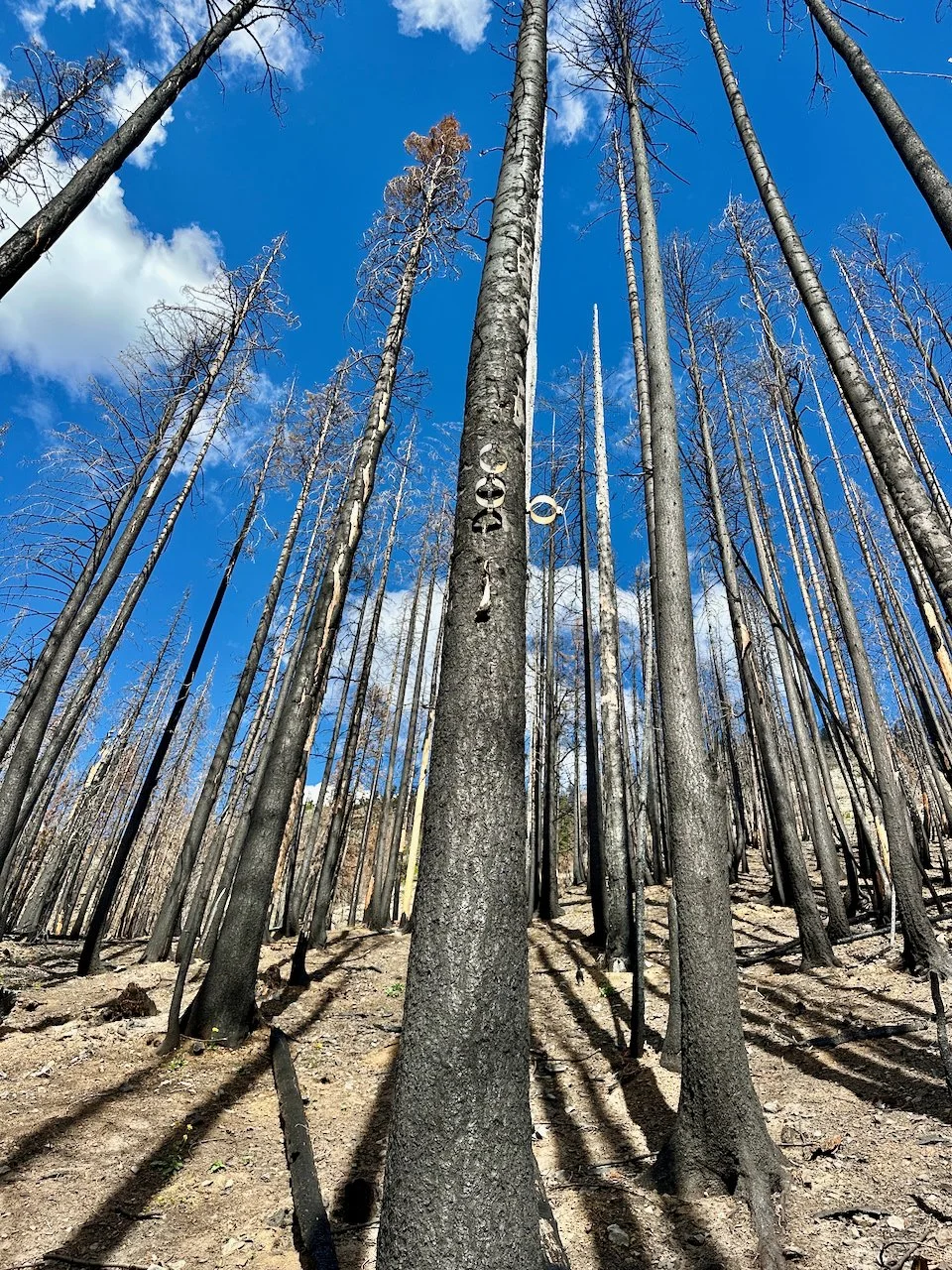
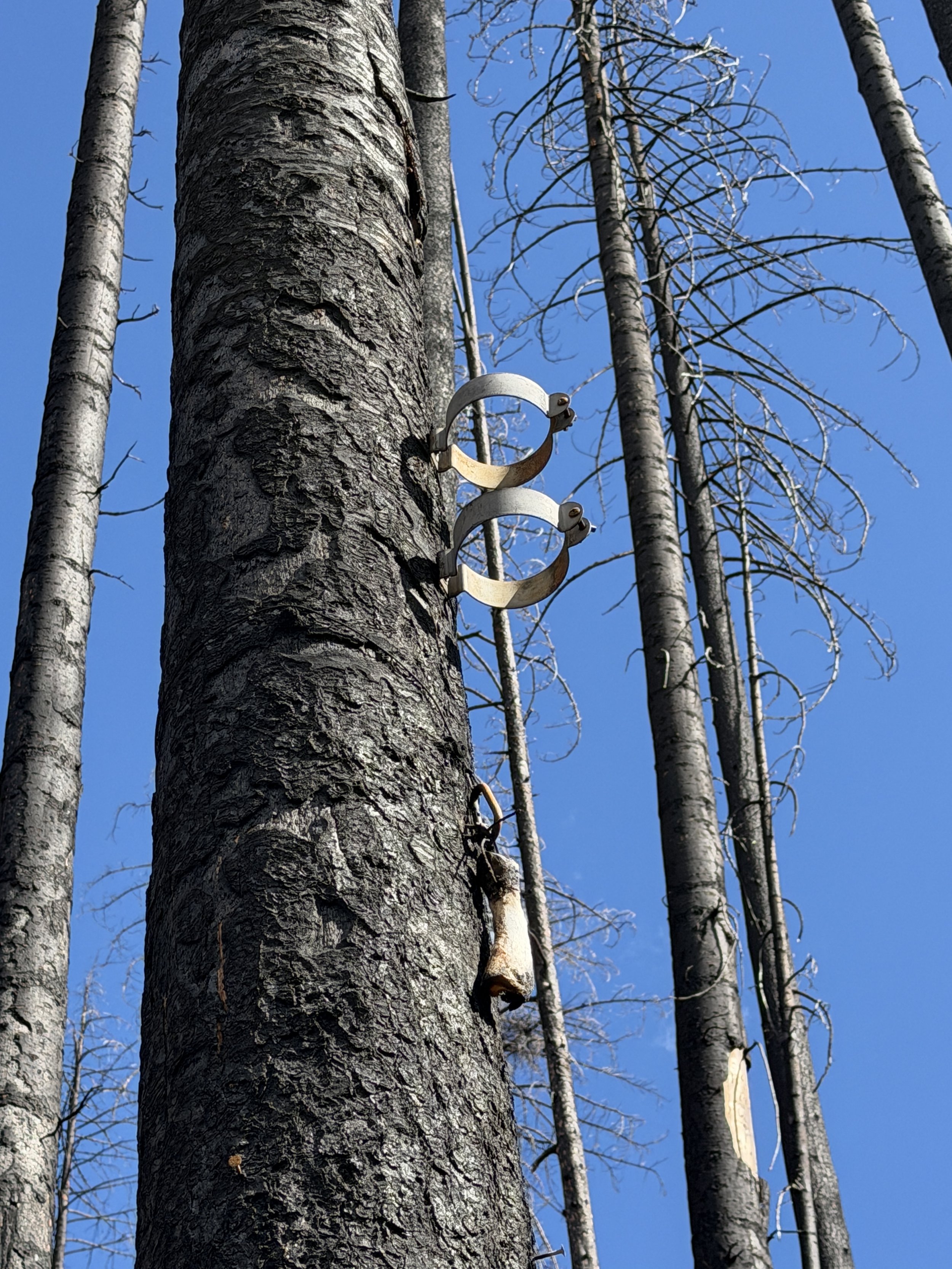
Images: Brackets for the scent dispenser, post-fire. Photo: CCMP/WPZ
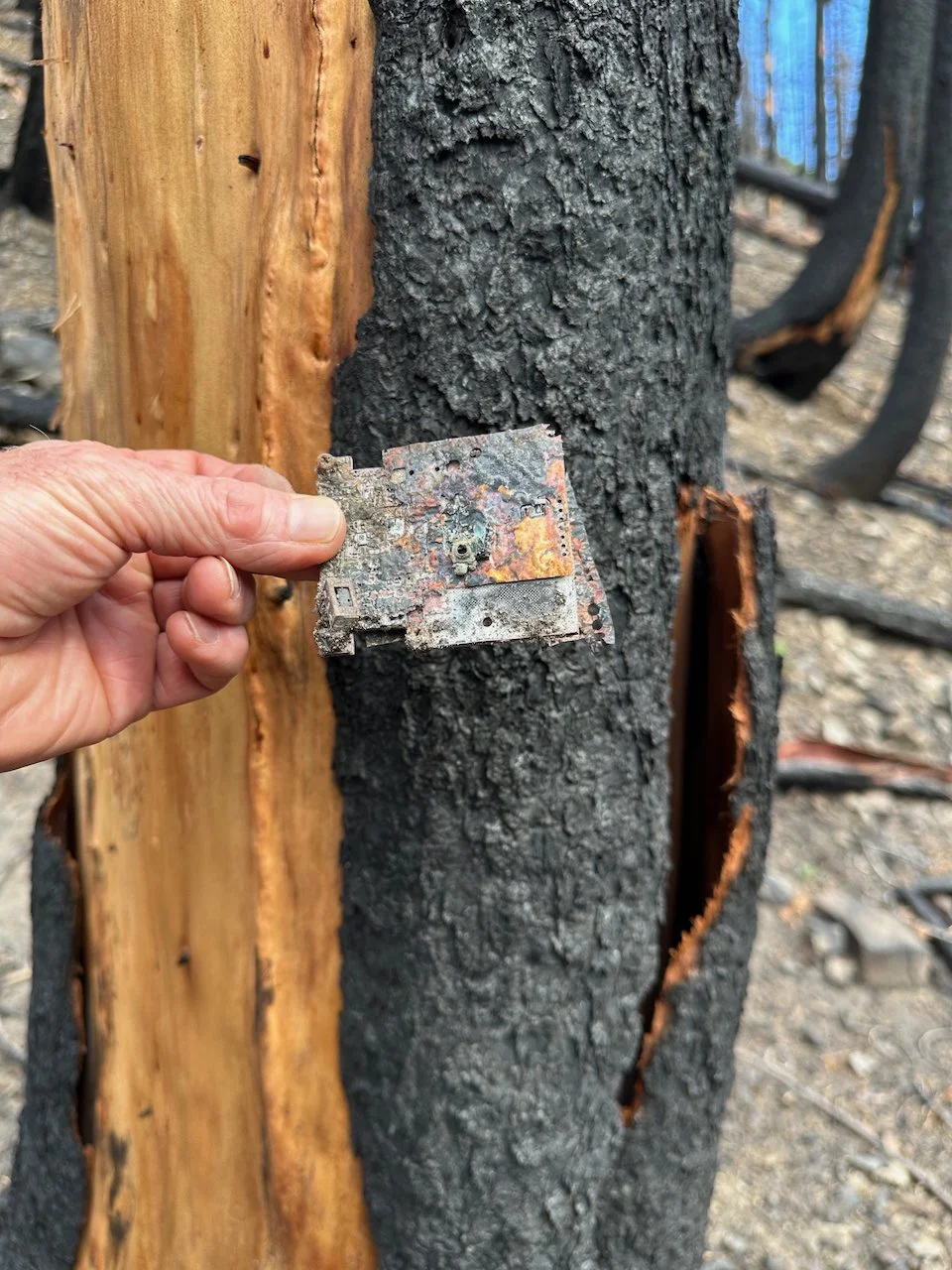
We eventually found our station by sighting the metal brackets that once held our scent dispenser twelve feet above the ground. The brackets themselves were still in position, but they now clung to a frail, blackened pole against a backdrop of blue sky. We somberly sifted through the debris on the forest floor in search of our cameras, which were reduced to mere fragments scattered about the site. No memory cards. No data. Only the haunting sound of a hermit thrush singing solo from the snag tops.
Our experience might have felt different if it were a seasonal one-off, or a beat in the natural rhythm of wildfires that preceded fire suppression and climate change—and persisted through millennia of Indigenous land stewardship. But we all know this is not the same story we face today. Each week, our CCMP postdoc, Dr. Travis King, prepares a wildfire threat assessment summarizing risks to our camera stations. Travis’s spreadsheet sparks mounting alarm, many cells highlighted in red, orange, and yellow. Thus far this field season (I’m writing in August), approximately 25% of our 42 overwintered stations are under high threat from wildfires, and 3 stations—including the one in the Teanaway—have already been lost. This pattern is a blow to our research, of course, but it also emblematic of the growing threat climate change poses to lynx, wolverines, and other climate-sensitive species in the Cascades and beyond.
Just last night, I read the following statement by wildfire expert Dr. Brian J. Harvey, in the July 8th newsletter of the Washington State Climate Office:
“Although wildfire activity in the Northwest (or more broadly across western North America) can be variable from year-to-year, the last 3 decades have seen consistent trends in rising temperatures, reduced snowpack, and more active wildfire seasons.”
The author’s appraisal wasn’t new to me, but it delivered an especially powerful punch given our current field season. I was also struck anew with the importance of CCMP’s long-term monitoring for informing conservation policy, connectivity planning, and further actions to protect wildlife in the years to come—and, of bearing witness to how the populations we study respond to climate change and other human impacts, such as recreation. Indeed, numerous CCMP collaborators are highly concerned about the potential effects of recreation on wildlife, whose habitat in the Cascades is enjoyed by a rapidly expanding audience of hikers, backcountry skiers, mountain bikers, and more.
Image: Remains of a remote camera, after the fire. Photo: CCMP/WPZ
Based on a power analysis led by Dr. Robbie Emmett, we’ve set the cadence for CCMP’s monitoring efforts at 2 years on, 2 years off—which means we’re now removing overwintered cameras deployed in our second year. These off-trail camera sets are designed to detect wolverines, although they also capture photos of other rare carnivores; for example, wolves, fishers, and putative Cascade red foxes. In addition, we deployed nearly 300 summer-only, on-trail cameras in 2024 and 2025, primarily targeting lynx, but once again detecting other species of interest, too. In sum, not including the off-trail data being retrieved this summer, we’ve classified more than 35,000 wildlife sequences using the AI-boosted Wildlife Insights platform. These invaluable data will be summarized in a 2-year report late this year and will populate occupancy models being developed by Travis with guidance from CCMP’s data analysis working group.
Meanwhile, CCMP collaborates with Canadian researchers to extend survey efforts using CCMP’s protocols and survey design into southern British Columbia. Led by Dr. Joanna Burgar with the B.C. government, the resulting project, Transboundary Research and Action for Carnivore Conservation, aims to “advance transboundary carnivore conservation through bi-national scientific collaboration among a diversity of partners who together promote standardized data collection, integration, and analysis.” Go, team!
Robert and I will soon return to the Teanaway to replace our lost camera station. This and two dozen other CCMP off-trail stations contribute to a periodic, multi-state wolverine survey that was last conducted in 2021. When we hit the trail again, I will channel the hope embodied by our broad-based partners, and the love we share for the Cascades and carnivores, to look past the burn and toward a more resilient future.
Image: A black bear visits the CCMP camera station in late 2024—before the fire. Photo: CCMP/WPZ
To learn more about CCMP and access annual reports for 2024 and 2025, please visit https://zoo.org/carnivoremonitoring/.
For more of Paula’s writing, visit her blog at paulamackay.com